[Archive] Moving onto new research ...
I'm just in the process of publishing my latest research for the LEF, so it's time to move on to a new area of research. Before I do, I thought I'd post something about the past research and a quick summary of a few of the points worth noting.
Explosions of industrial creativity rarely follow the invention, discovery or subsequent innovation of a technology but instead its commoditisation i.e. it wasn't the discovery of electricity but Edison's introduction of utility services for electricity that produced the creative boom that led to recorded music, modern movies, consumer electronics and even Silicon Valley. However, utility provision of electricity did more than just create a new world, it disrupted existing industries (both directly and through reduced barriers of entry), it also allowed for new practices and methods of working to emerge and even resulted in new economic forms - such as Henry Ford's Fordism.
This isn't a one off pattern. The cycle of innovation / commoditisation repeats throughout our industrial history, following a surprisingly consistent pathway. Understanding this pattern is critical to anticipating the changes emerging in our industry today - whether that's the web, cloud computing or the future changes that 3D printing will bring.
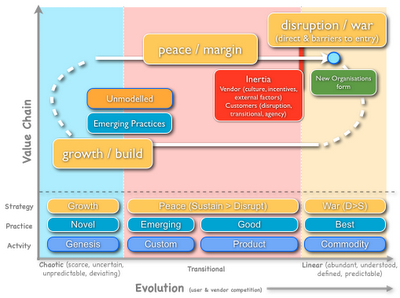
The actual cycle itself is rather simple but as with all things it creates complex interactions. I've tried to summarise some of the effect in figure 1 (below) and I'll go through it in the general notes.
 General Notes
1. All business activities evolve through a common pathway. This pathway is defined by how ubiquitous and certain (i.e. well understood & defined) an activity is. The relationship between these two I have previously discussed on many occasions. What's important to remember is that activities evolve through domains including genesis, custom built examples, products (including rental services) and commodity (including utility services). What drives the process of evolution is user and vendor competition
General Notes
1. All business activities evolve through a common pathway. This pathway is defined by how ubiquitous and certain (i.e. well understood & defined) an activity is. The relationship between these two I have previously discussed on many occasions. What's important to remember is that activities evolve through domains including genesis, custom built examples, products (including rental services) and commodity (including utility services). What drives the process of evolution is user and vendor competition - i.e. the need for something and the desire to supply that need and outcompete others.
- there are forcing strategies which companies can deploy i.e. use of open source, network effects etc.
- there are many counter strategies which companies can deploy i.e. use of patents, branding, legal system and ownership of lower orders of the value chain. * the characteristics of the stages are why no "one size fits all" methodology works i.e. in project management agile is most suited to the chaotic where deviation is desirable and structured methods (e.g. six sigma) are most suited to the linear where deviation is not desirable. * there are multiple ways of exploiting the cycle to your advantage * organisations consists of a mass of activities and therefore can be in different states of the cycle at the same time and even have multiple fronts at the same time (i.e. multiple parts in a state of war). * this entire cycle occurs throughout an organisations value chain and hence from simple premises creates a complex world of management.
- linear activities tend to low margin but are stable whereas chaotic activities tend to high margin but are unstable. Creating a profitable and sustainable company requires a constant balance of both. * many of the memes of modern management e.g. "business alignment" are consequences of how we structure ourselves and ignore the impact of evolution.
- the cycle is accelerating We can see the effects of this model clearly today. For example, cloud computing which is simply the shift of various IT activities from a product to a utility service domain (a more evolved form) which has been initiated by companies not encumbered by the previous model (Amazon etc) and hence have broken the inertia barriers has instigated a state of war. The normal round of customer "risks" (trust, transparency, governance changes etc) have been raised along with resistance from past vendors (e.g. dismissing of cloud). As a result of the state of war, new forms of organisation have emerged which have fundamentally different structures, strategies, practices and activities from the past. At the same time new architectural practices (resilience, scaling) relating to this activity (e.g. infrastructure) have co-evolved and are now diffusing. We have also seen the explosion of new activities built upon these commoditised component services along with increases of un-modelled data which the technology enables us to exploit (hence big data). We should increasingly see the disruption of past vendors who are stuck behind the inertia barriers due to their past success and hence have cultural, institutional and structural barriers to change. Equally the war will spread to other industries through the reduction of barriers to entry i.e. retail banking, insurance etc. I could go on with formation of competitive markets, role of standards etc but it's almost a text book classic of the cycle. The only thing that is surprising is how many people are surprised by the changes. Of course, cloud computing is based upon an underlying component which itself underwent this cycle. That component, which commoditised the means of mass communication, is the internet and it caused disruption (both direct and through reduced barriers to entry) of many industries from media to retail to travel. It also caused explosions of growth, un-modelled data, new practices and new forms of organisation - the web 2.0. Naturally, their practices (e.g social media, social networks ...) diffused amongst those companies that survived and adapted to the new economic state. That was also a text book classic of the cycle. Of course, the internet is a component of the next cycle which refers to the commoditisation of the means of manufacturing - e.g. 3D printing, printed electronics etc. It will have exactly the same effects but then I covered this in talk between 2005-2007 (based upon earlier research) and it's just the same old thing. The above is brief notes and this work was developed from my original models and research pre-2005 which I've used extensively in competition. It's only recently however that I've been able to extend the model to organisational evolution and obtain the volume of data necessary to be confident with the entire model. Its validation required a cycle of change. It'll still require another cycle before its predictive capabilities are fully tested though. None of the above is new to anyone that has been following me over the last five years, in fact it's probably very dull having heard much of it so many times before. I still find the nuances interesting, i.e. why companies in a peace mode that find themselves in a war state often attempt to reduce cost to restore profitability and hence quicken their demise or why you have no choice over evolution (Red Queen) of the impacts of Jevons' paradox or ... well there's lot. However, I'm moving on into how to really exploit evolution of the value chain and play the game. So I thought I'd just put this up here as a brief reminder to the work I've done.
Originally published on blog.gardeviance.org.